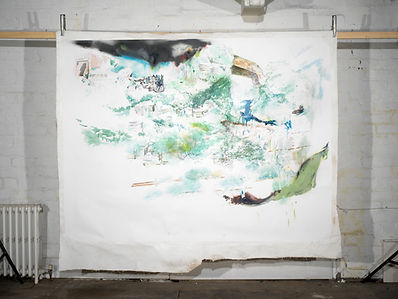
My paintings and drawings inhabit a world that is partly grounded in the familiar - a large amount of romanticism, nostalgia, memory and simply observation - and yet there is often a twist - sometimes subtle and sometimes blatant. It is an interplay between a real and fictional world, and has quite often been based around a brutality and conflict within an 'arcadian' ideal. Influences arrive from bizarre and mundane places, some perhaps seeping in from areas of myth, the paranormal, as well as the act of painting itself - the manipulation and application of paint and media as a response to the observed, or the perceived.
Born 1972, Heswall
Solo Exhibitions
The Williamson Museum and Art Gallery, Oxton, Wirral. July and August 2023
The Spotlight Gallery, Dean Clough gallery, Halifax. 2016
‘Vital Energy’ - at The Albert Dock, Liverpool, April 2008
Blackthorn Galleries, Birkenhead. November 1997
Selected Group Exhibitions
‘Looking At The Reflection Of Reality’, Mark Deveraux Associates, Castlefield gallery new spaces, Manchester 2014
Cork Street Open Exhibition, London, 2012
Liverpool biennial, 2010, via Editions Gallery, held at the Conservation centre, Liverpool.
‘Novas’ Contemporary Urban Centre, as part of the Liverpool Biennial, 20th September 2008.
The alTURNERtive Art Prize, The View Two Gallery, Liverpool, November 2007 to January 2008.
‘ReNew ‘06’ at John Moores University Gallery, Liverpool - April, 2006.
Waterstones bookshop, Piccadilly, London. Sept 2004
Visionfest, Albert Dock, Liverpool. 1997
Alternative Arts, Spitalfields, London. 1995
‘Candid Arts’, Islington. 1995
Hanover Galleries, Liverpool. 1994/ ‘95
Group exhibition as part of ‘The 218 project’ (the name of the bus route from Stoke-on-Trent to Leek) - ‘A tribute to packaging’: transforming and altering the images on disposable packages. Work displayed in a public House, near Leek. Spring 1993
Residencies
Artist In residence at Metal Culture, Edge Hill Station, Liverpool, September 2014 – September 2015
Residency in ‘The Loft Space Project‘, as part of Transvoyeur group, Elswick Street, Liverpool. 18th - 24th March 2007.
Work in Public (and private) collections in the UK and overseas.
Incl. Royal Liverpool University Hospital
Review by Andee Collard in Corridor 8 magazine
Landscape as a genre has its roots deeply embedded in Romanticism and its associated concept of the Sublime, which emphasises the power and grandeur of the natural world. Drawing from diverse sources and employing different mediums, Davies’ interpretation of landscape extends beyond its traditional generic boundaries.
Davies’ application of paint shows the gamut of approaches, from loose gestures to controlled precision. These artworks are not just representations of physical spaces, but also reflections on our complex, evolving relationship with the natural world. Through Davies’ work, viewers are invited to delve into this vast, fascinating subject and perhaps gain a fresh perspective on the landscapes they thought they knew.
The worlds Davies paints are a complex interplay of absence and presence. Parts of his paintings might showcase meticulously crafted details – a hill, a tree, a river. These areas of detail are often juxtaposed with expanses of negative space – parts of the paper left intentionally blank or minimally adorned. The result is a stark contrast that compels the viewer to ponder the deliberate incompleteness. Each of Davies’s artworks is an invitation to embark on a journey of discovery. The works are not static images meant for a cursory glance; instead, they reward closer, more careful inspection. His styles and approaches can be kaleidoscopic, switching between different methods and mediums within a single piece. The experience of observing his work is akin to navigating a dynamic terrain, where every twist and turn reveals something new.
Many pieces featured in this exhibition bear witness to a significant shift in the perception and depiction of landscapes, a shift brought about by one of the key inventions of the 18th century: the railway, which cut through and reshaped landscapes in a manner never previously seen and altered the way we saw and interacted with our surroundings. Davies’ works echo the process of rail lines fragmenting the terrain, as they present landscapes characterised by disjointed pockets of painterly information. ‘Off the Tracks’ (2014-15), for example, combines strong diagonals with a carefully depicted railway line, appropriated figures and painted areas in a variety of styles.
‘Off the Tracks’ (2014-15) by Rob Davies.
Perhaps most intriguing are the human figures that might emerge from the page, figures that inhabit these fragmented landscapes. They are phantoms born out of paint and paper, blending in and standing out in equal measure. These people add another layer of complexity to Davies’ works. They remind us that landscapes, no matter how desolate or untouched they might seem, are always inhabited – by us, by others, by stories and histories that are forever intertwined with the land.
The notion of landscape has become more complex during the Anthropocene. There’s hardly a corner of the Earth left untouched by human activities. The onset of the Industrial Revolution marked a turning point, creating a stark contrast between the human-made and what was perceived as pristine, untouched nature. The English writer Joseph Addison, during his Grand Tour in 1699, captured this complexity, observing that certain landscapes were capable of filling ‘the mind with an agreeable kind of horror’. His statement reflects a deep emotional response that is more nuanced than mere awe or appreciation of natural beauty. It speaks to the inherent conflict between human progress and the sanctity of the natural world, a conflict that is increasingly relevant today.
Davies’ at times gem-like creations meticulously articulate natural beauty in tandem with elements of human intervention — the harmonious alongside the discordant, such as railings or the casual wreckage of fly-tipping. In ‘Fly Tip’ (2015) a pastoral landscape scene is joined by an ominous black pool of spray paint. The urban connotations of graffiti-like paint is also used to great effect in ‘Embankment’ (2015), the scene defined by the spectre of dark paint, acting like a negative sky contrasting with the more traditional watercolour scene. His work elevates the everyday, transforming the ordinary into a realm of mythic magnificence through the thoughtful application of watercolour. It is in the seemingly mundane that Davies finds his muse, invoking a sense of the ethereal within the earthly.
‘Embankment’ (2015) by Rob Davies.
Elsewhere the works have a palimpsestic quality to them. ‘Controlled Demolition’ (2023) exemplifies this by showing an actual work in progress, where large swathes of the surface are currently left blank awaiting further intervention. Things feel temporary and provisional with works showing their production, such as hand-cut edges hung simply with bulldog clips directly on the wall. Vitrines in the central space of the gallery show studies and working drawings. The exhibition as a whole has an energy about it similar to a working artist’s studio: possibilities are everywhere.
Tension ebbs and flows throughout Davies’ oeuvre, creating an intricate dance of emotion. He showcases a masterful command of focus, overpainting in areas, applying layers, toying with scales, and then shifting perspectives. His works are living, breathing entities, a palpable dialogue between the artist, the viewer, and the world they inhabit, making each piece a testament to the beauty found in the fractures of our existence.
Rob Davies: Watercolours, Williamson Art Gallery and Museum, Birkenhead, 1 July – 26 August 2023.
Andee Collard is an artist, educator and co-founder of Bolton Contemporary, a non-profit organisation dedicated to providing inclusive contemporary visual art to the people of Bolton.
This review is supported by Williamson Art Gallery and Museum.
Images: © bigcheese.co.uk 2023.